
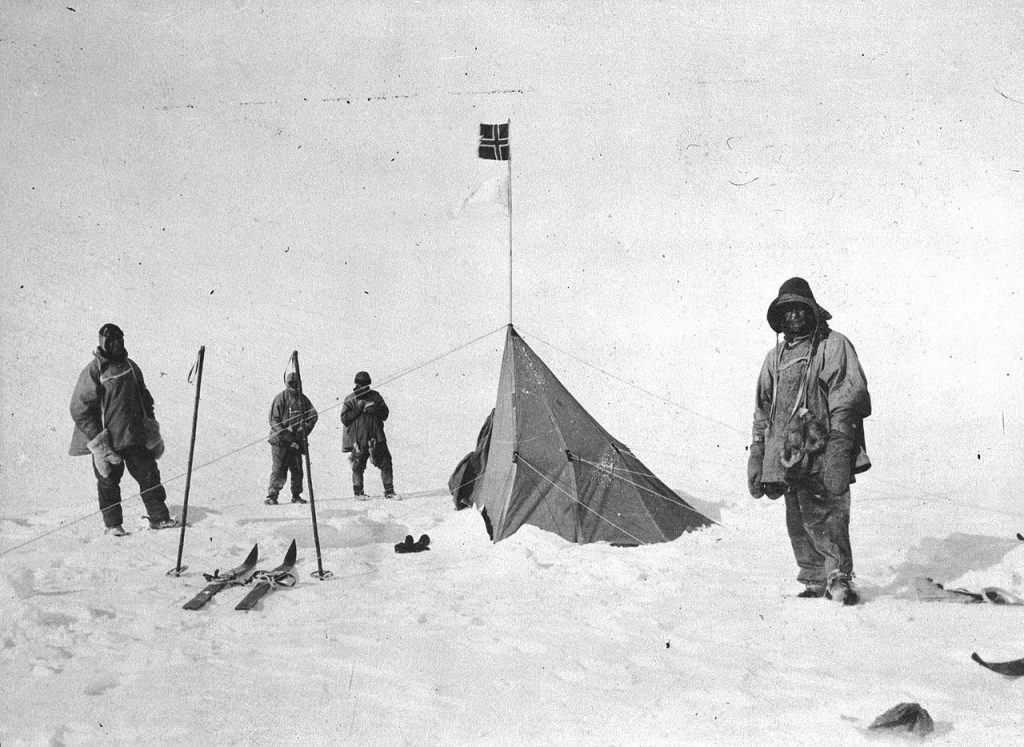
In October of 1911, two men raced for the same frozen finish line, for reasons that had nothing to do with women and everything to do with what women, a century of research later, would turn out to want. Roald Amundsen spent years studying Inuit cold-weather technique, packed dog sledges he’d tested to failure, and ran his five-man crew like the load-bearing structure of his own survival. Robert Falcon Scott packed motor sledges that froze solid within a week, a set of ponies unsuited to the terrain, and a chain of command built on the quiet English assumption that willpower beats planning. Amundsen reached the Pole first, fed his men well, and brought all five of them home fat and intact. Scott arrived five weeks later to find Amundsen’s flag already frozen into the ice, then died on the return march eleven miles from a supply depot he was too proud, too depleted, and too badly organized to reach.
History remembers Scott as the tragic hero and Amundsen as the guy who won. Women, it turns out, have been quietly picking Amundsen the whole time.
That’s the entire argument of this piece, dressed up in a hundred years of attachment research, one deeply unglamorous statistic about waist-to-chest ratios, and a University study on rejection so brutal it should come with a content warning. What makes a man attractive — for a second date, for the sixth year of a marriage, for the particular kind of trust that lets a woman hand you her undefended self — was never really about jawline, or wit, or the size of his truck. It’s whether he’s running the operating system of a man built to be relied on, or the operating system of a man performing reliability for an audience that includes himself.
The body science is real, briefly, because it deserves one honest paragraph before we move past it. Waist-to-chest ratio is the single strongest physical predictor of male attractiveness researchers have found, edging out BMI by a wide margin and leaving waist-to-hip ratio nowhere at all. But even that number is downstream of something quieter: a man who trains and eats like he respects his own body is broadcasting a mindset before he’s said a word. The shape is just the paperwork. The signature underneath it is discipline.
Which brings us to the part of the industry that got rich selling men a forgery of that signature. For twenty years, a whole economy of coaches has promised that attraction is a lock you pick — that the right neg, the right red shirt, the right dominant frame will override a woman’s judgment like a jailbroken phone. It doesn’t work, and we now have the receipts. A 308-person study on “negging” found women rated the tactic as actively harmful and rated its more evolved, socially-fluent versions as more toxic, not less — flagging them as a probable pipeline to real emotional abuse. A separate replication project ran 830 men through a red-shirt attractiveness test and found nothing: no bump, no edge, just a color. Pheromones don’t survive a double-blind trial. NLP is, per the actual scientific literature, pseudoscience with a font. And when researchers built a fictional tennis player named John and dialed his “dominance” up or down, the version of John that women found least appealing to marry wasn’t the meek one — it was the aggressive one. The control group who got zero personality description at all rated John higher than either version. Bravado isn’t neutral. It’s a debit.
Here’s what actually moves the needle, installed properly, and expressed in a life instead of a bar:
The Weather You Bring Into the Room
Roughly half of adults carry a secure attachment style — comfortable with closeness, comfortable with distance, not catastrophizing when a partner needs either. The other half runs on nervous systems tuned to treat intimacy or space as a threat. And because attachment lives in procedural memory, the same wiring that handles riding a bike, it doesn’t announce itself in words. It announces itself in a hallway, at an estate sale, on a random Saturday that was supposed to be nothing.
Picture two versions of the same second date. Craftsman house, dead man’s tools laid out on folding tables, sun coming through windows nobody’s washed since the Clinton administration. She’s two weeks into seeing this guy. She drifts into the next room to dig through a crate of records.
Version one. He trails her by half a step the whole morning, hands jammed in his pockets, eyes tracking her instead of the merchandise. When she comes back:
“Hey, you good? You were gone a while.”
“Yeah — found some old Nina Simone records.”
“Oh, cool. I just wasn’t sure where you went.”
“I was in the next room, Mark.”
“Right, no, totally — I just didn’t want you to think I ditched you or something.”
She’s not thinking about the records anymore. She’s thinking that it’s eleven in the morning and she’s already managing someone’s feelings, and that if two weeks in feels like this much upkeep, year two is going to be a full-time job.
Version two. He’s genuinely absorbed in an old hand plane at the tool table, turning it over, in no visible hurry to know where she’s gone. When she surfaces:
“Found the record crate. You didn’t even notice I left.”
“I noticed.” Easy grin, doesn’t look up right away. “Figured you could survive Estate Sale Bin Diving without a chaperone.”
“Careful, that’s flirting with abandonment.”
“You lived. Now show me what treason you committed against my music taste.”
She’s thinking that he’s not performing calm — he actually has it, some baseline steadiness he’s not borrowing from her attention. That’s rarer than it should be, and she knows it the way you know a level floor by how the marble rolls.
The Difference Between Amundsen and a Guy Who Read About Amundsen
Status runs on two separate engines: dominance, which is intimidation and control dressed up as confidence, and prestige, which is competence and generosity that other people hand you freely because you’re useful to have around. A cross-cultural study spanning thousands of college students across Singapore, Hong Kong, Norway, and the UK had participants build an ideal partner on a fixed budget of traits. In every culture, kindness got the biggest slice — more than looks, more than money, more than anything else on the sheet. Generosity in economic games gets rated as more physically attractive, too, which means moral beauty is quietly doing the job people assume only bone structure can do.
Then there’s the study that should be required reading for anyone still cosplaying alpha energy: 4,508 U.S. adults evaluated men in a hypothetical threat scenario. Men who physically stepped in to shield a partner were rated highly desirable — regardless of how strong they actually were. Men who stepped away and let the threat happen were penalized hard, across both friendship and romance. Physical strength isn’t attractive because it’s strength. It’s attractive because it’s a proxy for will you actually use it for me.
Four months in, first real weekend trip, driving back from a cabin at dusk when the tire blows on a two-lane road with no bars on either phone.
Dominance, unearned. He’s out of the car fast, kicks the flat once for reasons neither of them could explain later, wrestles the jack under the bumper instead of the frame.
“I got it. Just — hold the light still.”
“It’s already still.”
“It’s shaking. Can you just — never mind, I’ll do it.”
“Do you want me to try calling someone from up the hill?”
“I don’t need you to call anyone, I need you to hold a flashlight.”
She’s watching his jaw and thinking that this is a flat tire on a quiet road with zero actual danger in it, and he’s already this brittle. Filing that away for later, for the version of this night that has real stakes in it.
Prestige, earned. He’s crouched by the wheel well, unhurried, narrating without being asked.
“Jack goes under the frame, not the bumper — bumper’s decorative, frame’s structural. Basic rule of trucks and boyfriends.”
“Do you actually know how to do this, or are we improvising?”
“Little of both.” A grin she can hear more than see. “Hold the light there — you’re crew now.”
“What’s my cut?”
“Gas station coffee. Non-negotiable.”
She’s thinking that his calm isn’t coming from the situation being fine — it’s coming from him trusting himself to handle whatever it turns out to be, and that he made room for her inside that instead of shutting the door on her. That’s the whole trait, condensed into a roadside twenty minutes: competence that doesn’t need an audience, offered freely instead of hoarded for effect.
The Kitchen Table Is Where Marriages Actually Happen
Long before couples argue about anything real, they’ve already decided, unconsciously, whether conflict is a verdict or a project. The destiny mindset treats every friction point as proof the relationship was a mistake — not the one, guess I was wrong. The growth mindset treats the same friction as the actual terrain the relationship gets built on. And underneath both is something older: Imago theory’s observation that people unconsciously choose partners who replay the exact emotional patterns of their childhood, then either read every neutral behavior as a rerun of that old wound, or use the friction as the one place real healing was ever going to happen.
Four years married, eleven at night, laptop open to a budget spreadsheet, dishes still in the sink. He wants to leave a stable job to start something of his own. She wants to look at the numbers one more time before either of them says yes.
Destiny mindset, personalizing.
“I just want to talk through the numbers again before we commit to anything.”
“So you don’t think I can do this.”
“I didn’t say that.”
“You didn’t have to. It’s always the same with you — every time I want something, you find the hole in it.”
Silence. Arms crossed. She’s thinking she asked about a spreadsheet and got handed a referendum on the entire marriage, and that nothing in this house can apparently be discussed on its own terms anymore without becoming a fight about whose side she’s on.
Growth mindset, curious.
“I just want to talk through the numbers again before we commit to anything.”
“Okay — what part’s worrying you? The runway, or the getting-clients part?”
“Both, honestly. Mostly the six months with no income.”
“Fair. What if we build a hard stop — six months, and if it’s not covering half our expenses by then, I go back to consulting. Does that change how this sits with you?”
A pause. “…Yeah. Actually, yeah.”
She’s thinking he didn’t need her fully on board to stay steady — he treated her worry as a problem the two of them were solving together instead of an attack he had to survive. That, more than any grand gesture, is what team looks like at eleven on a Tuesday.
Warmth Is a Currency, Not a Default Setting
There’s a finding in social psychology called the gain phenomenon: people are consistently more drawn to someone who starts reserved and warms up than to someone who’s warm from the first second. Consistent, uncalibrated warmth reads as low-status neediness — the golden retriever setting. Earned warmth reads as a resource with a price on it, which makes it worth having. The same logic governs boundaries: a man who folds to every external demand isn’t being kind, he’s being porous, and a woman watching him do it isn’t reassured — she’s taking notes on what happens the day the demand is hers to lose to.
Six years married, Thanksgiving planning underway, his mother on speakerphone in the next room with that particular tone that means she already knows what she wants.
Porous.
“…so you’ll come here instead, right, like always?”
“Yeah, Mom, of course, we’ll figure it out.”
He hangs up. His wife’s already heard the whole thing.
“We already told my parents we’d be there this year.”
“I know, I’ll deal with it. Don’t make this a whole thing.”
She’s thinking he just negotiated away her holiday in ninety seconds without her in the room, and then acted like her reaction was the inconvenient part.
Differentiated.
“…so you’ll come here instead, right, like always?”
“We’re doing my in-laws’ this year — we settled that back in September. You and I are still on for the weekend after, though, I already blocked it off.”
A pause on the line, then he hangs up.
“That was almost suspiciously smooth,” she says.
“Four years of practice not flinching.”
“You didn’t even apologize to her.”
“Nothing to apologize for. We made a plan. I’m allowed to keep it.”
She’s thinking she didn’t need him to fight his mother for her, and she didn’t need him to throw her under the bus to keep the peace either. She just got chosen, calmly, without a scene. That’s the whole trick of a differentiated man — he doesn’t need her to change to make him comfortable, and he doesn’t rearrange his spine to make someone else comfortable, either.
Installing the Update
None of the above is a personality you either have or don’t. It’s wiring, and wiring gets rewritten through repetition, not through reading a listicle and nodding. Here’s the actual mechanism:
1. Somatic naming. The instant you feel the amygdala hijack — tight chest, that itch to send an anxious text or go cold and vanish — name it out loud in your head: tight chest, sweaty palms, urge to text her four times. Naming the sensation drags the prefrontal cortex back online.
2. The two-second pause. Physically do nothing for two full seconds before you act. That gap is the entire difference between a reaction and a decision.
3. The exhale. Inhale four seconds, hold four, exhale six. The longer exhale is what actually triggers the vagus nerve and brings the heart rate down — it’s not a vibe, it’s cardiac physiology.
4. Cognitive reappraisal. Write the automatic thought down. Name the distortion — personalization, catastrophizing, all-or-nothing, overgeneralization. Build the balanced version. “She hasn’t texted in three hours, she’s losing interest” is personalization plus catastrophizing dressed up as insight. The reframe: “A three-hour gap is almost certainly her day, not a referendum on me, and I have a track record that says so.”
5. Graduated exposure. Rejection tolerance is a habituated skill, not a personality trait. Start small and stupid — ask a stranger for a breath mint, request a discount you don’t expect to get. Move up. Keep a log: prediction, actual outcome, how fast your body recovered. Every rep teaches the amygdala the same lesson Amundsen already knew — the cold isn’t as lethal as it looks from inside the tent, if you’ve actually prepared for it.
6. The 3-3-3 frame. Three dates before deciding if there’s a real match, three weeks to see actual patterns instead of a highlight reel, three months before anything gets called serious. It’s not a rule for slowing down out of fear — it’s a rule for gathering enough data that your decisions stop being performances for an audience of one.
Eleven Miles From the Depot
Scott didn’t die because he lacked confidence. He had plenty. He died because confidence was standing in for competence, planning, and the humility to learn from people who’d solved the problem before him. Amundsen won not because he wanted it more, but because he’d built the kind of operation other people could actually stake their lives on — and did, all five of them, walking back into base camp fat and alive while the world assumed the flashier expedition would obviously come home first.
Women have been running that same calculation on men for longer than anyone’s been keeping score. Not who performs the most certainty in the room, but who’s actually built the kind of internal operation I could stake something real on. Install the wiring. The flag will take care of itself.
Leave a Reply